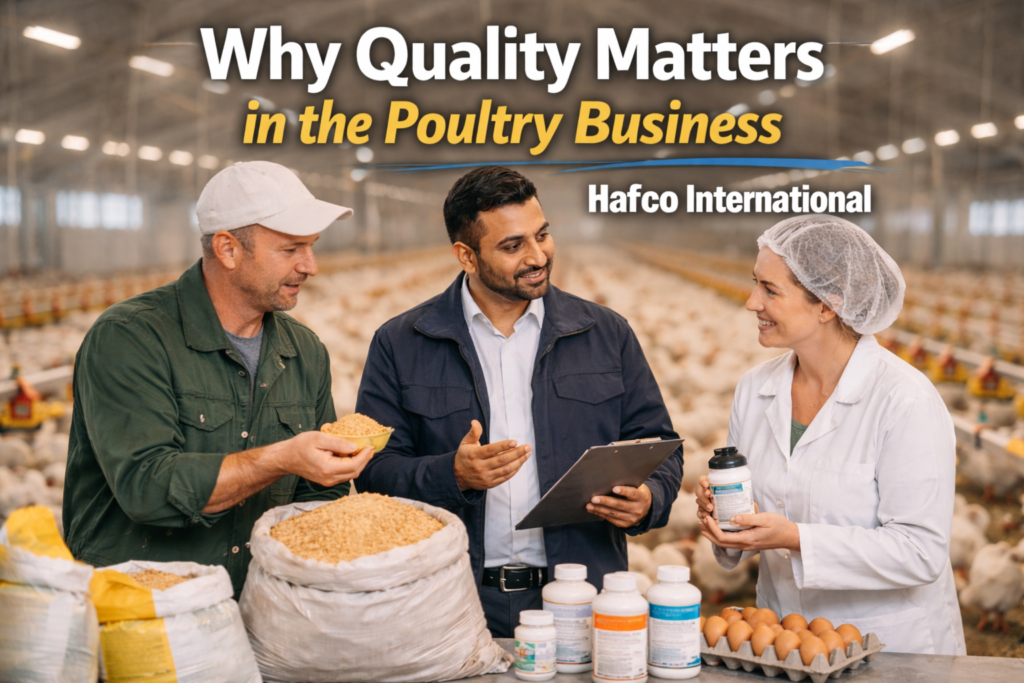
Why Quality Matters in the Poultry Business
Introduction
The poultry industry is one of the fastest-growing sectors in agriculture. From providing protein-rich food to supporting farmers’ livelihoods, poultry farming plays a crucial role in both local and international markets. But behind every successful poultry farm lies one fundamental principle: quality.
Whether it is the feed, equipment, farm management, or biosecurity measures, quality is what separates a productive, profitable farm from one that struggles with losses and inefficiency. For companies like Hafco International, maintaining high quality across all operations is not just a business practice—it’s a promise to farmers and consumers alike.
The Role of Quality in Poultry Feed
Feed is the backbone of poultry farming. Poor-quality feed can lead to low growth rates, weak immunity, and increased mortality. On the other hand, high-quality feed ensures that birds grow healthy, gain weight efficiently, and produce more eggs.
Key aspects of quality feed include:
Balanced Nutrition – Proteins, vitamins, minerals, and energy sources must be in proper proportion.
Consistent Standards – Every batch should meet nutritional standards without variations.
Safety and Hygiene – Feed must be free from contaminants like fungi, bacteria, or toxins.
Hafco International emphasizes sourcing and supplying only high-standard feed solutions, helping farmers achieve better growth rates, lower mortality, and higher overall profitability.
Quality in Poultry Equipment
Modern poultry farming heavily relies on equipment. From automatic feeders and drinkers to ventilation and climate control systems, every piece of equipment impacts bird health and farm efficiency.
High-quality equipment ensures:
Durability – Long-lasting performance reduces replacement costs.
Consistency – Automated systems provide uniform feeding and watering.
Efficiency – Reduces manual labor and operational errors.
Better Farm Environment – Proper ventilation, temperature, and humidity control improve bird welfare.
Investing in quality equipment is a long-term strategy. Farms using reliable tools experience fewer breakdowns, less bird stress, and higher productivity.
Farm Management & Operational Quality
Running a poultry farm is not just about birds—it’s about processes. Quality in farm management ensures that every step of production is optimized:
Biosecurity Protocols – Protects birds from disease and infection.
Record-Keeping – Tracks bird growth, feed consumption, and health trends.
Training & Support – Skilled farm staff ensure proper care and handling.
Routine Maintenance – Regular checks on equipment and facilities prevent major losses.
Hafco International often provides consultation services to farmers, helping implement standard operating procedures and management systems that maintain high operational quality.
Impact of Quality on Profitability
Quality in poultry farming is directly linked to profitability. Poor-quality feed, equipment, or management increases mortality, reduces production efficiency, and increases costs. Conversely, focusing on quality ensures:
Higher Productivity – Healthy birds grow faster and produce more eggs.
Reduced Losses – Less mortality and disease outbreaks.
Customer Trust – Farmers can deliver quality products to the market.
Sustainable Growth – Long-term farm success without constant losses.
Farmers who prioritize quality often see measurable returns on investment, making it one of the most important pillars of poultry business strategy.
Quality Assurance: Standards and Certifications
Maintaining quality requires a system. Leading poultry companies follow strict standards and certifications to guarantee their products’ safety and reliability. Examples include:
ISO certifications for feed manufacturing
HACCP (Hazard Analysis and Critical Control Points) for hygiene
Local agricultural compliance standards
These quality assurances are essential for gaining trust in the market and expanding business operations. Hafco International ensures that every product, from feed to equipment, meets these high standards.
Conclusion
In the competitive world of poultry farming, quality is not optional—it’s essential. It affects every part of the business: feed, equipment, management, biosecurity, and ultimately profitability.
Companies like Hafco International show that focusing on quality helps farmers achieve sustainable growth, healthier birds, and better returns. Whether you are a small farm owner or a large commercial operator, investing in quality is investing in success.
High-quality practices don’t just improve production—they build trust, reliability, and a strong reputation in the poultry industry.